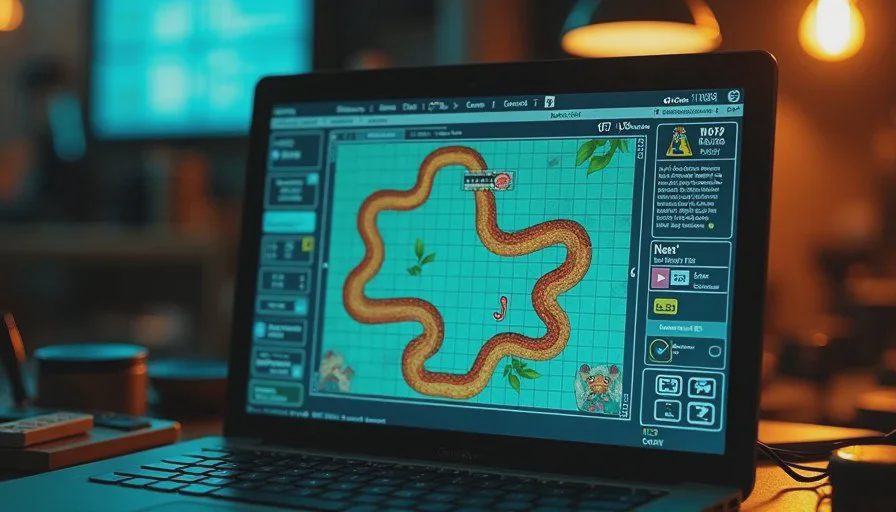
Real-time action selection is one of the clearest tests for a decision-first model. The system must repeatedly choose the next action from a small discrete set, do so under a tight latency budget, and keep doing it without accumulating errors that end the episode. Generated text is not useful here. The only artifact that matters is the decision itself—up, down, left, or right—together with the confidence attached to it and the time it took to produce.
The classic game Snake supplies a minimal environment that still exposes the relevant pressures. The state is fully observable, the action space is tiny, the consequence of a bad decision is immediate, and the episode can run long enough for latency tails and confidence drift to appear. This post describes how Snake is used on The Decision Bench as a field test for real-time decision-making. It does not report high scores or claim that any particular model masters the game. The value lies in what the setup forces into the open.
Why Snake Is a Useful Field Scene
Many decision benchmarks are static. A single input produces a single label. Real-time control is different. The model must operate in a loop: observe state, decide, act, observe the new state, decide again. Timing compounds. A decision that is only slightly late can place the agent in a worse state for the next decision. Confidence that looks reasonable on isolated frames can become misleading once the agent is deep into a long episode.
Snake keeps the complexity low enough that the decision model remains the focus. The grid is small, the rules are deterministic, and the failure condition (collision with wall or body) is unambiguous. At the same time the game is long enough and sensitive enough that poor latency, poor calibration, or brittle feature choices become visible within a few dozen episodes.
I treat Snake as a diagnostic environment rather than as a leaderboard task. The questions are practical: Does the model return an action inside the frame budget? Do the confidence scores separate clear situations from ambiguous ones? When the snake is forced into tight corridors, does the decision quality degrade gracefully or collapse suddenly? Those questions transfer to other real-time selection problems even when the visual surface looks completely different.
State Representation and Action Contract
The model never sees the raw pixels if a more compact representation is available. A typical state vector includes head position, direction, relative positions of the nearest body segments, distance to the food, and simple danger flags for the four adjacent cells. The exact feature set is recorded and held fixed for a measurement series.
The action contract is equally explicit. The model returns one of four discrete actions and a confidence score. Illegal actions (immediate 180-degree reversal when that is forbidden by the rules) can be masked before the decision or left unmasked so that the model’s tendency to propose them can be measured. I prefer to log both the raw model output and the action that was actually executed after any safety mask. The difference between the two is itself useful evidence.
Because the output is structured, every step can be written to a log with the same fields used elsewhere on this site: state summary or hash, chosen action, confidence, latency, and episode identifier. The log becomes the primary artifact for later analysis.
Latency Under Continuous Control
In a turn-based or frame-based loop the decision must arrive before the next state transition. The budget is usually a few tens of milliseconds on the platforms I test, sometimes less. A model that averages well under the budget but occasionally spikes above it will still produce visible failures: the snake continues with a stale action or skips a decision entirely.
I measure wall-clock time from the moment the state features are ready until the action and score are available to the controller. Individual step times are kept, not only averages. The upper percentiles matter more than the mean once the agent is running continuously. Thermal effects on mobile or sustained load on a browser tab can stretch the tail even when the median looks comfortable.
Cold-start behavior is separated from warm stepping. The first decision after model load often includes extra initialization cost; later decisions do not. Mixing the two produces a latency picture that does not match sustained play.
Confidence and Decision Quality Over Time
Confidence scores in a static classification setting are already easy to misread. In a sequential control setting they become more informative and more dangerous.
When the snake has clear open space and the food is in an unambiguous direction, high confidence is expected. When the snake is forced into a narrow corridor or when multiple moves appear equally viable, the score should drop if the model is well behaved. I log the confidence at every step and later examine its distribution conditioned on outcome (episode continued versus episode ended on the next few moves).
A model that maintains high confidence right up to a collision is exhibiting a different failure mode from a model that shows declining confidence as the situation becomes constrained. Both failure modes are useful to record. Neither is visible if only final episode length is kept.
I also track simple policy-level statistics: frequency of each action, frequency of immediate reversals (if not masked), and the rate at which the model proposes an action that the safety layer has to override. These counts are cheap to maintain and often reveal brittleness earlier than aggregate scores.
Failure Modes That Snake Surfaces
Several recurring failure patterns appear in this environment.
Latency spikes under sustained load cause the agent to act on outdated state.
Over-confident decisions in constrained geometry lead to collisions that a lower-confidence policy might have avoided by hesitating or choosing a safer exploratory move.
Feature choices that work in open space fail when the body occupies most of the adjacent cells; the model has never been forced to rely on those features during earlier training or evaluation.
Long episodes expose gradual drift: the same model that plays cleanly for the first hundred steps begins to make systematically worse choices as the body lengthens and the free space shrinks.
Each of these patterns can be isolated because the environment is simple and the log is complete. In more complex real-time systems the same underlying problems exist, but they are harder to attribute. Snake makes the attribution easier.
What the Field Test Does Not Claim
Success on Snake does not imply success on richer control tasks. The state space is tiny, the dynamics are deterministic, and there is no partial observability beyond what the feature representation itself discards. A model that selects good actions in this environment can still fail when the observation is high-dimensional, the action space is larger, or the dynamics are noisy.
The test also does not replace static accuracy or calibration measurements. It adds a sequential, latency-sensitive dimension that static tests omit. Both kinds of evidence are required before a decision-first model is treated as a candidate for real-time selection in a product.
Finally, the test does not require the model to achieve long average episode lengths before it becomes useful as a diagnostic. Short episodes that end in clearly logged failures are often more informative than long episodes whose internal decision quality was never examined.
How This Scene Fits the Rest of the Site
Field Tests place decision models inside concrete loops rather than isolated examples. Bench Tests supply the latency, memory, and calibration methods that are reapplied inside the Snake loop. Deploy Notes examine what changes when the same decision model moves from desktop to browser or to Android while still driving the game. Failure Log entries begin from the exact steps where high confidence met a collision or where a latency spike forced a stale action.
The governing rule remains unchanged. Show the state. Show the action that was chosen. Show the confidence. Show the time it took. Keep the conditions visible. When those elements are present, Snake stops being a toy and becomes a practical probe for real-time action selection with a decision-first model.



No comments yet — be the first to share a thought.